After General Motors’ bankruptcy, there is no question that the automobile industry will change significantly. With less competition and higher costs of production, prices will increase. It will be more difficult and more expensive to find parts and service for some vehicles. The selection of vehicles will be more limited.
Perhaps more brands will opt to adopt the sales philosophy held by Saturn and Scion: the price advertised is the price you pay. At first, the concept seemed like a scam. You always negotiate car prices, but with Saturn’s entrance to the market, the manufacturers or dealers said, “Don’t negotiate with us anymore; it’s our price or no sale.”
This method, where cars were sold more like a commodity than a luxury, proved to be quite popular, especially with younger individuals who do not have haggling experience. Taken to the step beyond prix fixe voiture, cars could be sold “off the shelf” in retail stores rather than dealerships. According to US News & World Report, at least one retail outlet in Mexico sells cars in addition to other typical retail products, and the United States may follow.
Just about the only place to buy a car these days is a traditional dealership, thanks largely to powerful franchise laws in most states that keep other competitors at bay. But as automakers slash their retail networks, dealers are losing their clout. For new offerings such as minicars, and perhaps cheap Chinese imports, a big showroom with a dedicated sales staff might not even make sense. That could open the way for retailers like Costco or Wal-Mart to start selling cars.
This may be the future of automobile sales: View the floor models in an open area of the massive store, talk to the salesperson, and as if the product were a high-definition television, let the salesperson try to talk you into the extended warranty and other options. Wait for him to bring the car from the stock garage in the back to the cashier, where you pay the price on the sticker. Perhaps you’ll put your purchase on your credit card (store credit will be offered) and earn loyalty points.
I expect most popular brands, like Honda and Toyota, might not accept this model. It may be suitable for lower tier brands and low-cost models not yet popular in the United States. The New General Motors may see this sales avenue as the path back to profitability.
Would you prefer to buy cars from retail stores like Wal-Mart or Costco if this new sales philosophy reaches the United States?
The economy is not out of the woods yet. Companies are still laying off employees; the automotive industry is just getting started. For many families, the pressure is on to find ways and make decisions to save more money in order to prevent going into or going deeper into debt.
The situation presents a good opportunity to review spending across the entire budget, optimize income, and decide where to draw the line between necessities and luxuries, true needs and wants. The opportunity exists to choose poorly, to cut back in spending in ways that seem to make sense in the short term but may be harmful later on. Some struggling families have no choice but to focus on the short-term, immediate survival, but these mistakes should be avoided whenever possible.
Delaying visits to the doctor and dentist, especially for children. If you have no insurance or can’t afford the copyaments or coinsurance, you may feel like you have no choice to ignore your “regularly scheduled maintenance” appointments with health professionals. I admit that I don’t visit my doctor for check-ups as often as I should, regardless of the cost. But if you put off these visits now to save money, it could end up costing much more in the long run if health problems — some that you may not know about — are allowed to grow. A few years of skipped dental hygienic appointments, saving anywhere from a hundred to a thousand dollars, could result in several thousands of dollars in corrective work.
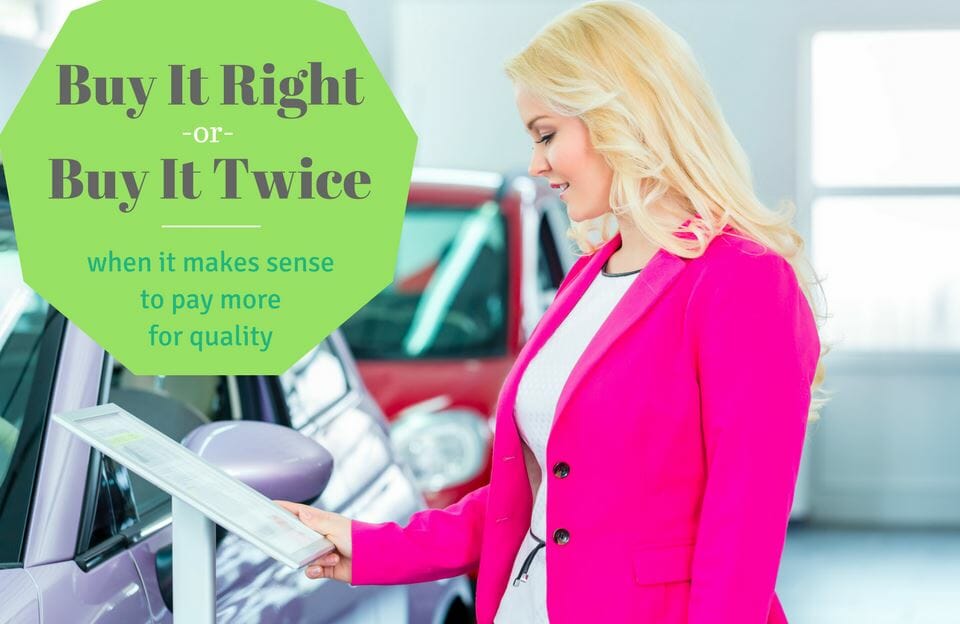
Choosing cheaper, poorly-made products. When I was younger and had very little net income to work with, if any, I tried to save money on clothing by shopping where clothing was the least expensive. After a few years, I realized how the cheap clothing I was purchasing, for example jeans from Old Navy costing ten dollars, did not last more than a year. I could spend twice as much at a store that offers better quality clothing and the purchases would last five to ten years.
It’s similar with cars. I drive a Honda Civic now. It was comparatively inexpensive when I purchased it, but I haven’t had any problems until this week when the fuel door stopped functioning. That is apparently a common problem for Civics, and it was not free to have fix. I chose to get it repaired because I am willing to spend more money rather than do it myself, do it wrong, and cause more problems. But rather than purchasing a Civic, I could have purchased a similar car from a different, lower-quality maker and saved money. But according to reviews and statistics, I would have spent more money to maintain any number of other cars due to lower levels of reliability.
Consumer electronics are similar. Cheaper products might save money for the initial purchase, but if the electronics must be replaced or returned for service after the warranty has ended, you will end up paying more.
Buying products in smaller packages. If you have six dollars in your wallet and you need to buy toothpaste, you can buy a package that will last six months. If you only have three dollars in your wallet, however, the only option to you is a smaller tube that will only last two months. At the time of purchase, you’re saving money by buying a smaller tube, but the price per ounce is going to be better if you have the six dollars to spend. Sometimes you don’t have a choice, but smaller packaging is not the best way to save money.
This is true for bulk purchasing, as well. When the economy is strong, people are more likely to buy in bulk, with an eye towards the future. But if you do not know where your next pay check is coming from, focus shifts to the short-term.
Opting to enroll in store credit cards. It is tempting to open an instant credit card in order to receive 15% off your purchase, a common offer in department stores. While the immediate discount sounds nice, by adding a credit card to your arsenal, likely a credit card with a high interest rate, you could end up far exceeding the price you would pay if you chose not to open the credit card. That is what the credit card companies are counting on.
It is not always possible to avoid the decisions that hurt your wallet more later than they do now. But when it is possible, or if you can find a way to cut back in other areas of spending that do not have long-term effects, you will have more opportunities to make the better decisions as described above.
According to early news reports, General Motors will file for bankruptcy one hour from now, at 8:00 am Eastern Time this morning. GM was officially born as a company on September 16, 1908. Its long history is a reminder that no company will survive forever regardless of its performance; like humans, corporations are mortal and if you want to see one fail, you just have to wait long enough.
Bankruptcy isn’t truly death, however. General Motors has the opportunity to restructure, shedding its poor performing businesses. Thanks to a massive government bailout, GM can renegotiate with its creditors. The government will own 60%, a controlling share, of the new General Motors. With this massive restructuring, you can expect a new GM that will look and and operate quite differently, and the changes will affect many different people throughout the world. Here is how GM’s bankruptcy might affect you.
General Motors employees and retirees
By the end of next year, General Motors predicts it will cut 20,000 jobs. 2,400 dealerships and 12 plants across the country will be closed. This is after the company has been reducing its staff consistently throughout the decade. 300,000 employees at dealerships will be affected by the cuts.
General Motors retirees will see their benefits, such as health insurance, reduced.
Suppliers and other companies that rely on General Motors will also be affected. There will be job reductions throughout the entire automotive industry.
General Motors vehicle owners
Not much will change for General Motors’ customers. Warranties will continue to be valid, with a government guarantee for back-up insurance. Maintenance and other service might be more expensive with fewer parts suppliers and dealerships available to provide competition in the marketplace.
GM will eliminate a number of its brands to focus on the vehicles that show a potential for profit. The company will have to be more aware of the marketplace and remain as flexible as possible to respond to market demand. This could mean some new, more fuel efficient cars if this remains a priority. With the Administration pushing for tougher regulations in the automotive industry, this may be a necessity regardless of popular interest.
General Motors stockholders and bondholders
If you own GM’s stock, you have already been affected by the anticipated bankruptcy. The stock price, currently trading at $0.75 per share, has fallen 95.74% over the past year. Any investment held in General Motors will only be recovered if the restructuring is a success and the government relinquishes its equity.
During the bankruptcy, GM’s stock will likely be unavailable to trade. Standard & Poors will likely remove General Motors from the S&P 500 and the same fate is predicted for GM’s inclusion in the Dow Jones Industrial Average. The company was already removed from the S&P 100 last year. This presents one drawback of index investing: failing companies are often represented as thee value of their shares fall to zero, but fast-growing companies, which would normally balance out those that fail, are not picked up by the index until they have already experienced their greatest growth.
If you invested in a corporate bond from GM, you will lose your investment. Your bond rights will be replaced by a portion of stock in the new General Motors.
Overall thoughts for the consumer
With any luck, General Motors will emerge from bankruptcy and from government control a leaner company ready to compete in the automotive industry. General Motors’ current state shouldn’t be a reason to drive potential customers away from their vehicles. GM’s cars should continue to be evaluated on their performance, safety features, fuel economy, cost to own, and pleasure, just like any other vehicle produced by any other corporation.
I have been helping my girlfriend shop for a car during the past couple of weeks, and we’ve noticed in the dealerships we have visited that there is very little in stock. Lots are half empty, and this does not apply to General Motors only, or even only “domestic” automotive makers. The prices for what we can find are somewhat competitive right now, but I expect prices to rise over the next few months as the industry reacts to the loss of jobs, suppliers, and competition.
According to Alan Greenspan, this is of the first types of spending that consumers give up when a recession is felt personally. When men come to the point at which they need to save more money than usual and decide to cut bank their spending, underwear is at the top of the list of possible reductions. Because underwear is invisible to the public, man apparently have no shame in letting the fabric deteriorate more than they would when a flush bank account would allow them to replace tattered undergarments when necessary.
Furthermore, an increase in underwear purchases could signal the beginning of a recovery. If this is true, it’s bad news for the economy in the next few years. Underwear industry experts are predicting no growth in sales until 2013.
I have not noticed any decline in my own undergarment purchases. My overall spending on clothing has remained strong as I have been replacing some of the clothing I’ve owned for ten years or more, some of which no longer fits anyway. My underwear doesn’t necessarily last as long before I replace the old clothing with something new.
Purchases of women’s underwear does not correlate to the recession. Any time is a good time for buying lingerie.
Have you reduced your clothing purchases, particularly underwear, to save money this past year?
If you can’t answer this question because you don’t know how much you spend on clothing, consider tracking your expenses for a period of time. You might find you have some opportunities to save money across your entire budget.
June 12, 2009 is the final day that full-power television stations will broadcast in an analog over-the-air signal. The date was originally set for February 17, but due to broadcasters who needed more time and congressmen who felt the public needed more time to understand the transition, the deadline was extended until next month.
This also has provided companies more time to create confusion in an effort to sell products and services.
Cable companies like Cablevision use the digital transition to try to convince holdouts still using antennas that the best way to avoid a problem is simply to sign up for a yearly contract, with a special “low-cost program.” They might be right. If you have cable or satellite service, you will be immune to the digital transition. Virtually all cable companies serve digital signals into homes now. But the low-cost program offered might provide you with fewer channels than you have now as a customer of free, over-the-air broadcast television.
Retailers use the digital transition as an excuse to convince consumers that it’s time to upgrade to a high-definition television. I routinely talk to people who are convinced that they need to buy a high-definition television in order to watch any television after the transition date. This was never true. A digital television is not the same as a high-definition television broadcast. You can watch digital television on your older cathode ray tube (CRT) television. You do not need to buy a new television, even if your old box has only an analog tuner.
At the very minimum, you will need to buy a digital converter box if your television has only an analog tuner. There are coupons available, two per family if you apply for the coupon before July 31, to help defray the cost of two converter boxes. If you buy a converter box, keep this in mind: Even after the digital transition deadline, some low-powered stations may continue broadcasting in analog only. If you want to receive these stations after the transition, you must buy a converter box which offers a feature called “pass-through,” which allows analog and digital signals to be sent to your television.
If you use antennas to receive analog television now, the same antennas will receive digital television. Digital signals are weaker, though, so you may find in order to receive digital reception that is comparable to your old analog reception, you’ll need an outdoor antenna.
Several times a week, I get a phone call from a number I don’t recognize. The caller never leaves a voicemail message, so I always perform a quick Google search to see if I can find any information about the caller before answering or returning the call. In almost all cases, the unknown number has attracted numerous complaints online.
According to the complaints listed for each phone number that has called me unexpectedly during the day, if I were to answer the phone, I would be talking to a pre-recorded telemarketer whose job is to sell me an “extended warranty” for my car.
Even individuals who have placed phone numbers on the Do Not Call registry (more information on Do Not Call) are being bombarded by this telemarketing agency. The Federal Trade Commission is suing the companies behind these “robo-calls,” Voice Touch Inc. and Transcontinental Warranty Inc.
After September 1, telemarketers may only use “robocalls” when a customer has opted in to this particular “service.” Have you received any calls from these companies?
Seven years ago, when people I knew were buying houses they couldn’t afford with the philosophy that real estate prices always go up, and the go up fast, I was sitting on the sidelines. I had no money, no desire to settle down, and no belief that real estate in the form of home ownership was such a sure thing. Years later, I had a chance to see the real numbers behind the true cost of owning a house for 30 years, and I was not impressed. For all that people say about real estate appreciation, there is a lot you don’t hear about often.
To truly determine how much you earn on a house from the moment of purchase to the moment of sale, you can’t ignore all the maintenance costs and other fees you are required to pay in order to live in that home. Buying a house for $500,000 and selling for $600,000 two years later is not a real 20% return when you consider you spent $30,000 in taxes, $15,000 for a new patio, $10,000 for a remodeled kitchen, your closing costs when you purchased the house, and the Realtor’s commission when you sell. The home you live in barely beats inflation over the long term when you factor in all costs, unlike long-term investing in a broad selection of stocks like an S&P 500 index fund.
MP Dunleavey mentioned that more people are beginning to think the same way I have been thinking, and taking this approach much farther than I have. These “transumers” eschew ownership wherever possible in favor of a more transient existence, supported when necessary by renting and leasing. “Rather than spending your money on individual things, which you then have to keep (suddenly an old-fashioned idea), you purchase access to an array of objects and experiences. It can save time as well as cash: The more you own, the more you have to worry about, maintain and upgrade.”
Renting is often cheaper than owning, even over the long term.
When you count gas, maintenance, insurance, repairs, loan payments and depreciation, the average cost of car ownership is $8,095 a year, according to AAA. Yet the majority of cars in North America are driven only 66 minutes a day, according to a 2008 study by Susan Shaheen of the University of California, Berkeley. That works out to about $20 an hour, two to three times the hourly cost of car sharing.
I don’t think a service like Zipcar would work for me because most of my driving is my daily commute, but the transient lifestyle lends itself to leasing a car. Leasing usually includes a contract that is not favorable to the consumer, and most related financial advice warns to avoid leasing a car. But in cases where leasing is more expensive in the long run than buying, or you have no asset at the end of the contract, you could consider the increased cost the price you pay for not needing to deal with the pains, headaches, and expenses of owning the car.
Every time you add to your possessions, you add to your responsibility and in many cases your expenses. Rather than being tied down to material objects, you can spend your money on experiences or save for the future.
After a few years of not catching onto consumers’ shifting tastes towards more environmentally friendly vehicles, General Motors has teamed up with Segway to develop the PUMA, or Personal Urban Mobility and Accessibility, a tiny self-balancing, two-wheeled vehicle powered by electricity. The PUMA can reach speeds of thirty-five miles per hour.
It’s an interesting concept, but much like the original Segway, I don’t think it will catch on except in unique circumstances. The only place I see Segways are in shopping malls, where they drivers are part of the facilities security or police. I have had my own personal experience with a Segway; several years ago, I rode one of these devices in Disneyland’s Tomorrowland exhibition.
Dean Kamen, the inventor of the Segway, created massive hype before unveiling the Segway, promising it would revolutionize urban transportation. He would have predicted that these personal transportation devices would be ubiquitous by now, particularly in cities. That hasn’t come to pass yet. In fact, Segway is judged to be a failure.
How the PUMA device is heading in the same direction. But perhaps there is room for success; I have seen an increasing number of Smart Cars on the roads and in parking lots.
Here’s a video of GM and Segway’s collaborative PUMA vehicle. Can you see yourself in one?