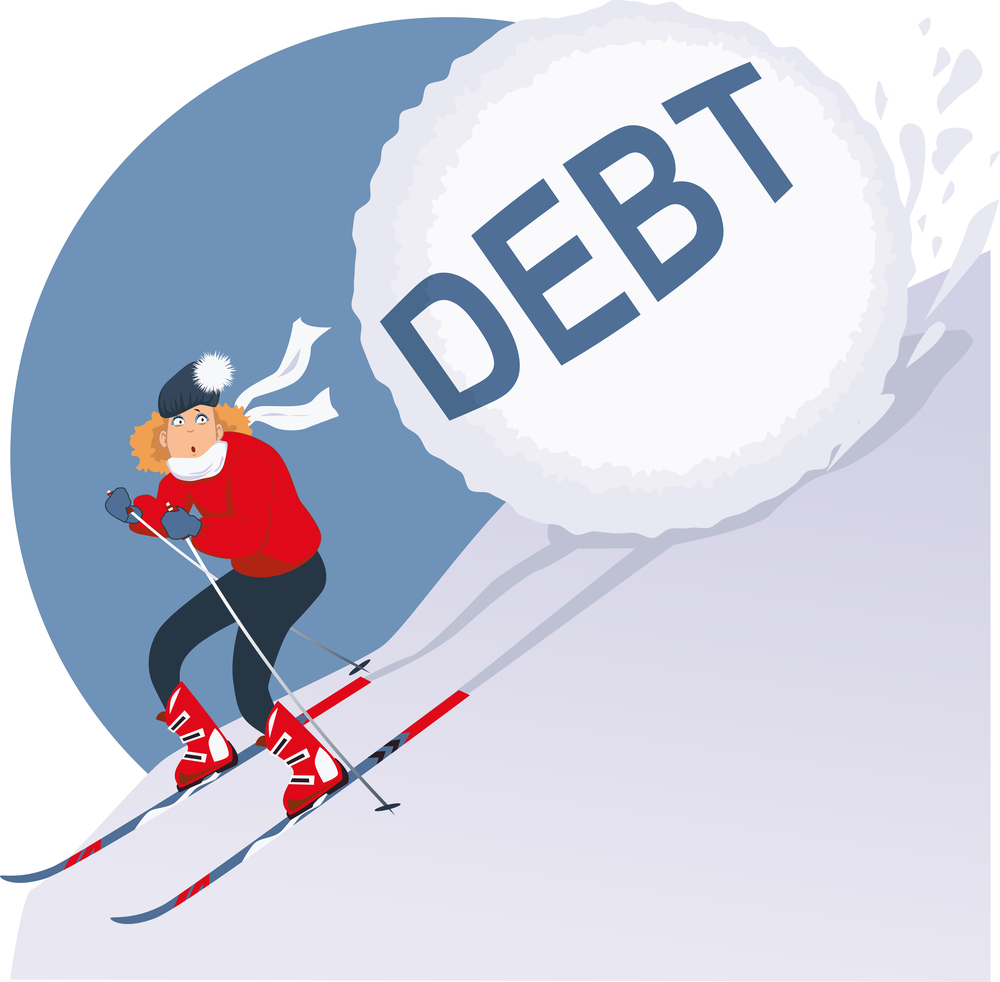
The Correct Way to Pay Off Personal Debt: The Debt Avalanche

When it comes to mathematics, certain facts are universally agreed-upon. For example, regardless of your culture or educational system, you must agree that one plus one equals two unless you mistakenly fall for an invalid proof. When dealing with money, why are people inclined to believe that one plus one does not equal two?

If you have a certain amount of money available to pay off a portion of your debt each month, even if that certain amount changes, there is a mathematically correct way of paying off that debt. You can call this approach the Debt Avalanche. It is similar to Dave Ramsey’s popular “debt snowball” method, with one small but important detail: With the Debt Avalanche you will pay off your debt faster and pay less total interest to banks and lenders.

The simple calculation for the Debt Avalanche requires only the interest rates for each debt account. This assumes that all debt accounts have the same tax liability, but if that’s not the case, determine your interest rate after taxes for this calculation.

Step 1. Order your debts from highest interest rate to lowest. You may find credit cards at the top of the list. It’s typical to see interest rates from 10% to 20% or more. Credit cards offered by stores often have the highest interest rates, so you might find these at the very top. Watch out for promotional rates ending, which they may do on the date promised when you enrolled, or earlier. Card issuers also re-evaluate their customers every so often, and will not think twice about raising your rates midstream. Note that if your credit improves, they will not magically lower your rates. While lenders will notify you if they intend to raise your rates, you may have missed the notice.

Your mortgage and home equity loan may be the next debts in line. It’s important for your list to capture every debt for which you make a monthly payment. Student loans may be the last on the list, particularly if you qualify for tax credits. The Debt Avalanche formula won’t work properly if it covers only a portion of your debt, so consider all accounts.

Order your list from the highest interest rate (after tax) to the lowest. You may have noticed we didn’t factor in your account balances in the above formula. That is because your individual account balances are irrelevant. The issue solved by the Debt Avalanche is the best way to pay off your total debt with all available funds.

Step 2. Pay the minimum to all debts every month. If you’re writing down your list, or using a spreadsheet like Excel, add a column next to each debt to list its minimum monthly payment. This is the amount you will pay towards each debt, except for the one account listed at the top of the list.

Another column should list the payment due date if it is relatively static from month to month. For example, my credit card payment is due on the last date of almost every month, so I would write “30.” This would indicate to me the last date of every month. Your payments should always arrive before the due date. In fact, in some cases, you can reduce your total interest paid by paying weeks in advance of your due date.

Step 3. To your debt with the highest interest, send all extra available cash. If you have an emergency fund, this step is simple. Since it’s unlikely that you can earn more in savings than you can “earn” (reclaim) by paying off your debt, all your unused income after paying expenses (necessary and discretionary as you see fit) should be dedicated towards the debt account with the highest interest rate.

Step 4. Repeat every month. You cover all your bases by ensuring every creditor receives the minimum payment, but you hone in on only your debt with the highest interest. Once a debt account has been eliminated—and it may not be the account at the top of the list if other balances are smaller—remove it from the list and re-order if interest rates have changed.

It’s that simple. This is mathematically the best method for paying off your personal debt. No other method will get you out of debt faster and save you as much money.

Despite the facts, many people disagree. The primary reason detractors, or supporters of the “debt snowball” method, may argue is that Dave Ramsey’s method will help you pay off your smaller debt faster, providing you with “early success” and possibly the motivation to continue along the path of debt reduction. The Debt Avalanche will also provide early success, but if you need special motivation to continue your monthly payments, consider this: By choosing the Debt Avalanche method, you will pay off your total debt faster, you will pay less interest, and you are mathematically efficient.

That is motivation enough. Or is it?

Dave Ramsey believes his “debt snowball” method, in which debts are paid off in the order of balance from lowest to highest, has shown better results than any other method thanks to “quick wins.” If he were to ask his followers if they want to carry their debt longer and pay more interest throughout before offering the “debt snowball” method, they would choose the faster, cheaper, better option of the Debt Avalanche.

One of the many reasons people can fall into debt is the difficulty of separating emotional thinking from rational thinking. The Debt Avalanche helps separate these two methods of thinking, as the best financial decisions are almost always the rational decisions. But it helps to pay attention to some of the psychology involved, as well.

The possible motivation due to the “early success” aspect of the debt snowball method is cited by many followers to be its strongest point, encouraging debt reducers to continue down the path. Followers of the mathematically and financially superior Debt Avalanche, if they need this sort of motivation, can achieve the same effect by defining milestones.

Rather than “celebrating” when your first full credit card or other debt account is paid off, take note and reward yourself when you’ve paid off your first $1,000 (or $500 or $10,000, whatever is applicable to you). Setting and achieving these short term goals influences the same area of the brain (the mesolimbic system) as the act of paying off the first credit card and are similar enough to provide the same motivational results.

Quick wins may help to motivate debt reducers to continue along the path, but the real win comes in knowing you’ve made the smarter choice.

Updated on July 8, 2008 with more information about redefining milestones to address the psychological effect of “quick wins.”

Scroll down to read 43 comments on “The Correct Way to Pay Off Personal Debt: The Debt Avalanche.”

Did you enjoy this article? If so, please share!
Add to: Tip'd | Facebook | Delicious | Reddit | Digg

Get the RSS feed or enter your email address:

Related Entries on Consumerism Commentary

43 Comments on “The Correct Way to Pay Off Personal Debt: The Debt Avalanche.” To add your own comment, scroll down.

  1. #1: Twiggers
    Monday, July 7, 2008
    8:29 am (reply)

    I used this avalanche method and have paid off $36000 in less than 6 months. Still have $29000 to go! I call my rollover amount each month my snowball, but it really is an avalanche!

  2. #2: Kate
    Monday, July 7, 2008
    8:30 am (reply)

    I agree. I would always choose the avalanche over the snowball, for the very reasons you point out. The reasons provided in support of the snowball always struck me as quite odd.

    But then I realized that they do make sense for people with a certain mindset. Not to be offensive, but that mindset is not a logical, orderly, or deliberative mindset. The snowball probably works well for people who are deeply in debt from out of control spending and lack of financial discipline.

    So for those people who are going to backslide and return to an undisciplined approach to money unless they see the concrete result of paying off one debt in full very soon, I suppose that’s a great approach. I see it as a proof of concept situation for people who aren’t yet able to look at their finances from a strictly logical and efficient perspective yet. Better that (less efficient) method of debt reduction than no method at all, right?

  3. #3: Twiggers
    Monday, July 7, 2008
    8:34 am (reply)

    You know what though….you forgot one thing that happened to me. Your minimum payments on the remaining cards WILL go down slowly every single month. So you do need to tweak the monthly avalanche to take that into account. It might not seem like a lot, but it can quickly add up to an extra $25-50/month that could go to the avalanche.

    Also, I am not rolling my mortgage or student loans or car into this. I guess I see the mortgage and car loan as a secured loan….so I’d rather pay off the unsecured debts first and then worry about the rest. It could also be because the interest rates on those are typically lower than a credit card anyways.

    Also, one final thing. I would recommend that people doing this actively look for 0% balance transfer cards. This will ONLY work if you can chop up the remaining cards and be strong-willed. I just consolidated $20K of my credit card debt on a 0% interest card and am saving about $200/month in interest alone.

  4. #4: Jac
    Monday, July 7, 2008
    8:41 am (reply)

    “That is motivation enough.”

    Well, clearly it’s not, or this would work for everyone. Why does it bother you that people choose a non-mathematically optimal route to getting rid of debt? Just be grateful that you are one of the people who find spreadsheets and numbers interesting and motivating, and try and encourage others to work on it whatever way works best for them.

  5. #5: Flexo
    Monday, July 7, 2008
    9:22 am (reply)

    Jac: I wouldn’t say that it bothers me, everyone is free to pay down debt as they wish. Those who promote the “debt snowball” method don’t explain that this method keeps an individual in debt longer and and is more expensive. Spreadsheets are the same tools whether used for the “debt snowball” method or the “debt avalanche” method.

    If someone wants to use the “debt snowball” method, it doesn’t bother me one bit, as long as they understand that it is neither the fastest nor the cheapest way to use their available funds to get out of debt.

    Twigger: Good point about your minimum payments—they do change as you pay down your debt so you’ll have to be mindful of how much you’re sending to each debt account each month. Congrats on your progress!

    Kate: the undisciplined approach does not lend itself to paying off debt. If you’re serious about paying off debt, I believe it should be done efficiently. A slight change from the popular “debt snowball” method can make a big difference.

  6. #6: Ryan
    Monday, July 7, 2008
    9:33 am (reply)

    If you were to walk up to someone who was thousands of dollars into credit card debt and tell them to do something because it was “mathematically smart,” you tell me just how motivational you think you’d be. ;)

    What I mean to say is: people get into these positions because, to them, math doesn’t motivate, having something in their hands that they can see, that motivates.

    For these, Dave Ramsey is right on. Ramsey takes into account a “mindset shift” that has to take place. You don’t simply say, “This is better because it’s mathematically smart—let me get out my spreadsheet and show you.”

    First things first: people have to experience themselves impacting their own circumstances.

  7. #7: Flexo
    Monday, July 7, 2008
    10:36 am (reply)

    Ryan: People don’t get into debt because they don’t understand math, but because they are not exposed to the consequences of their spending. Dave Ramsey argues that having a small success (paying off your smallest debt first) quicker will motivate a former debtor to continue along the path, but if you tell that person that their small success is costing $x and adding y months to their total payback period, then it’s hard to imagine anyone not feeling hoodwinked for following an inferior debt reduction method.

    With the debt avalanche method, your first “small success” (defined by paying off a debt account fully) could take place at the same time as it would with the debt snowball method, if your smallest debt also has the highest interest rate. So it’s possible that the first small request would come as soon as it would otherwise, rendering the “benefit” of the snowball method irrelevant. But in the chance that it doesn’t, redefine the first “small success” to be a certain dollar amount, say $1,000 total paid off across all accounts. A milestone like that can be a motivational factor as well as anything defined by the snowball method.

    I understand from personal experience how different things motivation different people and things like this should be tailored to the individual’s needs. If it is explained in plain language to those wishing to pay off debt that it is more expensive and longer to use the debt snowball method, there is only one obvious answer. Then, if motivation is an issue, and if the time before the first full debt repayment is drastically altered by the method chosen, redefine your small successes to be milestones. This can be designed in such a way to be motivational to those same people who were motivated by the first full debt repayment.

    People are smarter than we give them credit for, even if they’ve found themselves in debt. Professing the debt snowball method is like a teacher instructing the entire 25-student class based on the needs of the one student within the class who is the least able and most reliant on hand-holding to perform a task.

  8. #8: KC
    Monday, July 7, 2008
    10:38 am (reply)

    The debt avalanche makes perfect sense for those who can handle it. But the debt snowball is still probably best for most people. They got into credit trouble from spending. They need instant results. That’s why they need to pay the smallest first – to get faster results and gratification. Ramsey promotes this cause he knows the average person can’t do the more reasonable, sensible thing – which is what you are proposing.

    One time my husband and I were listening to Dave Ramsey. He said, “Who is this guy? He’s such a d-bag to his listeners.” I told him who he was and that the reason he is so harsh is because his listeners are desperate and need to hear this in the maner he delievers or else it won’t hit home with them. That’s who guys like Ramsey are geared towards – those who are desperate, and need a quick approach, which may not always be the smartest.

  9. #9: Chris
    Monday, July 7, 2008
    10:42 am (reply)

    I agree mathmatically your method works, but not EMOTIONALLY for many people. That is why the debt snowball works for many.

  10. #10: Flexo
    Monday, July 7, 2008
    10:49 am (reply)

    Chris: I agree that the debt snowball method “works,” it just doesn’t work as well as the debt avalanche. I’ve already explained how to design motivation into the debt avalanche to make it work “emotionally” as well, but let’s face it… we should do our best to eliminate emotions from financial decisions of all kinds, not only debt repayment but investing decisions, etc. And to assume that people can’t do this doesn’t respect the intelligence of our fellow human beings.

    As I mentioned, the “emotional” response to a quick success can also be achieved with the debt avalanche method by redefining milestones. But if your debt reducer can’t see the big picture and choose the faster, cheaper, better option of the debt avalanche method, then they haven’t learned to separate money from emotions or to make intelligent decisions about their finances… and thus, they have a higher chance of ending up in debt again.

  11. #11: Flexo
    Monday, July 7, 2008
    11:06 am (reply)

    KC: I would hope that those who call into DR’s show understand what is in store for them in terms of attitude. Dave Ramsey’s show is about entertainment, after all, and of course, syndication. I’m sure DR has helped people get on the truer path to financial independence… but let’s help them more by saving them money and time when paying off their debt. By the way, by the time someone decides to listen to Dave Ramsey, they’ve already decided that they need to pay off debt, but they’re looking to learn how.

    That’s why the debt snowball method is so popular—it “answers” the exact question that listeners have when they finally decide to tune in and change their life. Unfortunately, it’s not the best answer.

  12. #12: Twiggers
    Monday, July 7, 2008
    3:28 pm (reply)

    I guess it really depends on the situation you are in. Financially it is always better to do the avalanche method, but psychologically, Ramsey’s method is better. When I first started I wanted instant results and decided to settle in the middle. I picked a card with an average balance and a middle of the road interest rate. Paid it off within a couple weeks and got some satisfaction. Then decided I was being stupid and wasting money and starting tackling the higher interest cards (by high interest we’re talking less than 10%). I personally think you can combine both and still get the motivational results and save money on the finance charges.

    here is another catch that people just won’t do. You NEED to change your lifestyle. Whatever lifestyle you were sustaining got you into this horrid mess. If you don’t let go of the lifestyle then no snowball or avalanche will change things. You need to cut back expenses, and somehow make more money in order to get out of debt! That is just plain common sense.

  13. #13: Patrick
    Monday, July 7, 2008
    3:30 pm (reply)

    I’m not sure about Dave Ramsey, but every blog or article I’ve seen explaining the debt snowball has pointed out that it isn’t as efficient but works for many people. I can’t believe people don’t realize that.

  14. #14: Benjamin
    Monday, July 7, 2008
    5:02 pm (reply)

    The trick is finding whatever works for you! I found wiping out the smaller debts first just to clear them out was best! But in the end it may of only cost me $20 in interest over the year and a half that it took my family to pay off over $97,000 in consumer debt.

    I love the name “Debt Avalanche”. This applies very well to my brother-in-law when my wife and I helped him snowball his debts. He actually had a Chevy Avalanche that was a large portion of his debt. Once we dropped that baby it was only a couple more months before we had him on “easy street”.

    regards,

    ben

  15. #15: Pete
    Monday, July 7, 2008
    7:59 pm (reply)

    I agree that your way is more financially sound, but I don’t think Dave Ramsey ever says that his way is the best way to do things mathematically. In fact we’re taking a Ramsey class right now, and in the video discussing the debt snowball he says outright that the debt snowball isn’t the best way to do things mathematically.

    What he does say though is that it works better in action because a lot of people who have gotten into debt aren’t there because they’re good at math. They’re there because they’ve made lousy financial decisions and life choices (in most cases – i realize some people are there because of medical emergencies, etc). They’ve spent money emotionally, and haven’t made wise choices. Chances are unless you give them a method that takes into account the emotional side of spending, they aren’t going to succeed.

    Having the small boosts from paying off smaller debts gives the momentum that a lot of those people need to continue down the path of paying off their debt. If instead they’re paying off the higher interest, and possibly higher balance debt – it takes longer, and the results don’t come as quickly. When they don’t see the results often they give up on making the payments because it doesn’t feel like they’re making headway.

    Personally we’re out of debt so thankfully we don’t have to deal with this. I think if I did have debt I would probably do things your way – but that’s because I’m more into numbers and keeping track of our finances. For most others – I think Ramsey’s method will probably work better.

  16. #16: Andrea Smith
    Monday, July 7, 2008
    9:00 pm (reply)

    When suffering from a large debt, consider your alternatives, negotiate with your creditors and know the next steps in consolidating your credit. Thanks for the article!

  17. #17: Julie
    Monday, July 7, 2008
    9:03 pm (reply)

    I just have issue with referring to the Avalanche method as the “correct” one. The correct one is the one that WORKS.

    It reminds me of weight loss – the most successful programs emphasize incremental changes and intermediate goals. When a person has 100 pounds to lose, it’s easier to focus on the first five instead of the next 95.

  18. #18: Flexo
    Monday, July 7, 2008
    9:32 pm (reply)

    Dave Ramsey’s plan “works,” but it is not the best choice. Both methods can emphasize incremental changes and intermediate goals. The “debt avalanche” is cheaper and faster. Anyone who makes the “debt snowball” method work can make the “debt avalanche” work by looking at the milestones in a different way.

    At first I believed the “debt avalanche” method was the best way to go. Then I realized that people who follow Dave Ramsey’s suggestion may have a point. Later, I came to the conclusion that the positive aspects of Dave Ramsey’s plan can be applied to the “debt avalanche” by looking at the milestones slightly differently as I’ve mentioned above. Not only that, but the “debt avalanche” method emphasizes separating emotional thinking from rational thinking, which is a good thing for those who have a habit of finding themselves in debt.

    When dealing with money, the best option is to put your emotions and ego to the side and accept that the best answers are always the mathematical answers. And yes, this is coming from someone who understands quite a bit about psychology. Not everyone is motivated the same way, but various motivation techniques—the same ones that work for the “debt snowball” method—can be applied to the “debt avalanche.”

    So if you’re serious about reducing your debt, there is no reason NOT to take care of it the most efficient way possible. You can be successful with either method, but if you want to save money and time, and if you want to prove to yourself that you can make intelligent decisions about money, do it the right way, the way in which you’ll pay less interest and finish faster.

    There is a time and place for the psychological aspects of money management, but this isn’t it, just like it’s a bad idea to buy or sell stock based on your emotions.

  19. #19: Patrick
    Monday, July 7, 2008
    9:45 pm (reply)

    You sound like telling the alcholic that the best way to get better is to never take a drink again. While you are right, human’s don’t operate like robots. Everyone of us reacts to situations in different ways.

    It isn’t always so easy for a credit addict to do as you ask though “snowballing” gives them the instant gratification that got them into trouble in the first place. It’s taking the flaw and making it work for them. As someone already said, whatever works to help you get straight.

  20. #20: Patrick
    Monday, July 7, 2008
    9:46 pm (reply)

    Or even better. It would be better mathematically for a smoker to go cold turkey and not buy the $30 drug prescription a month. However, it’s easier for them to kick the habit and be more likely to not start back up.

  21. #21: lulugal11
    Monday, July 7, 2008
    11:47 pm (reply)

    According to my understanding of the debt snowball you can choose EITHER the highest interest first or the smallest balance. I use the snowball term but pay the highest interest debt first.

    It is not what you call it that matters…what is important is that you are making an effort to reduce debt.

    With both methods you are paying the minimum on all debts EXCEPT one which is targeted to receive a higher than the minimum payment. When I was first learning about debt snowballs I was told this was the basis of dealing with debt…..the choice comes when you decide if to tackle the highest interest first or the lowest balance first.

    Different things work for different people and according to my financial situation I have switched from one method to the next. Sounds like you are just calling the same thing a different name here. Same principle.

  22. #22: Juggler314
    Tuesday, July 8, 2008
    8:00 am (reply)

    If you want to be technical about it being the most mathematically efficient way to pay off debt you should really be factoring in your state and federal tax brackets as well with respect to debts that have tax efficiencies. For instance, lets say you have a “bad” mortgage at 8.5%, and many other debts at 8%. If you are saving 20% of every dollar paid in mortgage interest – that could easily make the mortgage the “worse” debt to pay off even though it’s at the topy of the list interest rate-wise. As you pay that mortgage down, you’ll have less and less cash available to you as a result of your declining tax deduction.

  23. #23: Jesse
    Tuesday, July 8, 2008
    12:53 pm (reply)

    I love these lively discussions. Flexo, I think you should update your post and discuss the redefining of milestones because your comments have outlined it, but your original post didn’t. You have a great point there.

    The key to debt reduction—under any name—-is intensity.

  24. #24: Flexo
    Tuesday, July 8, 2008
    2:32 pm (reply)

    Juggler314: I touched upon the tax issue in the post—to compare interest rates correctly, you have to factor in all tax aspects to find your effective after-tax rate for each account. It’s a great point and often overlooked. Thanks for providing that example.

    Jesse: Thanks! I’ve updated the article to include thoughts about milestones.

  25. #25: juggler314
    Tuesday, July 8, 2008
    2:45 pm (reply)

    ah I missed that little bit about “same tax liability”. Usually all your debts have the same tax liability (for most mortals anyway) except mortgages though…so it’s a pretty big asterisk for the mortgage debts.

  26. #26: Flexo
    Tuesday, July 8, 2008
    3:07 pm (reply)

    Juggler314: The other consideration is student loans. Some people may qualify for a tax credit based on student loan interest paid.

  27. #27: dustintweir
    Wednesday, July 9, 2008
    1:37 pm (reply)

    Flexo, I have to say that your argument is somewhat passe.

    “We are more concerned with modifying behavior than correct mathematics…. I have learned that the math does need to work, but sometimes motivation is more important than math. This is one of those times.” -Dave Ramsey

    Your argument is presented, but your readers shouldn’t accept that “if your debt reducer can’t see the big picture and choose the faster, cheaper, better option of the debt avalanche method, then they haven’t learned to separate money from emotions or to make intelligent decisions about their finances.” Your highest-interest-rate-first method is mathematically superior (and that’s not a consession, it’s a fact made by plenty of bloggers way before you), but an intelligent decision for EVERYONE is managing the individual’s behavior. Some might do best with this method, some might do best with Ramsey’s motivation, some might do best by building up a cash reserve before tackling debt, some might do best by paying off secured debt before unsecured debt. You shouldn’t mislead your readers into thinking they’re retards that will always be in debt if they can’t figure out how to pay the high interest rate down.

    One personal example is on a recent trip to Canada I made a dozen or so purchases in a weekend. I managed the exchange rates OK, but the bank charged me a currency conversion fee which made me overdraft my account (and if you tell me I should’ve memorized the fee schedule, I’m going to kick you in the nuts). After this hit, I had a necessary vehicle expense which I couldn’t pay, and had to put it on my credit card. Because I’m not a robot and have a dynamic financial situation, I found it best to build up a small cash reserve in checking at, GASP!, 0% interest. Guess what! I don’t pay overdraft fees anymore, and I’ve completely stopped adding any additional credit card debt. At a card interest rate of 10% and an overdraft fee of $35, it’s MATHEMATICALLY better for me to hold $300 for a year as cash at 0% than to put it toward the debt, and I won’t expand my total debt if any unexpected expenses of less than $300 show up.

    To your readers: your most intelligent decision is whatever gets you out of debt, period. You’re plenty intelligent if you can simply accomplish that goal, and not try to follow a plan that doesn’t work for you that could theoretically save you $75 a year in interest charges. Take his advice, keep on reading, and do what’s best for you. (you genius, you)

  28. #28: jaushwa
    Wednesday, July 9, 2008
    5:16 pm (reply)

    great post. It seems more and more evident to me that the more you separate rational and emotional thinking, the farther you will go in finance. The debt avalanche is the perfect example.

  29. #29: troy
    Wednesday, July 9, 2008
    9:33 pm (reply)

    “mathmatically superior”

    I love that.

    It is mathmatically superior to pay off higher interest debts first. It is also mathematically superior to not have the debt in the firstplace….or is it. I mean, mathmatically why pay off any debt whose interest rate is lower after taxes than an alternative retun on investment.

    What about the opportunity costs of this mathematically superior way. It makes perfect sense with standard stepped debts, but what about odd situations.

    Say I have a mortgage at 7% for $500,000, a car loan at 8% for $50,000 and 20 credit cards with an average rate of 5.99% and an average balance of $2,000 each. (don’t laugh, I have seen it)

    According to mathematics, I should be paying off the mortgage first. Great. Now I get to pay on 22 separate debts, track them, reconcile them,etc for the next 20 years because it “mathematically” makes the most sense.

    Your thesis for”mathematics” fails to consider the most important of issues regarding personal finance. RISK

    No one ever give risk enough weight. Not paying off revolving debt cariies risk. juggling several debts carries risk. All debt carries risk. The interest rate is A factor, not THE factor. Balance is A factor. Risk is also a factor. Risk of rate changes, universal default,etc.

    The best way to eliminate debt is to pay off the RISKIEST debt first. Sometimes it is the one with the highest payment, sometimes the highest interest rate, sometimes the highest balance.

    You must also consider life situations. If you are trying to reduce your debts to qualify for a better rate on your new home purchase, lenders care about your MONTHLY debt obligations,not your TOTAL outstanding debt. Paying off a low interest (5%)car loan with a $700 monthly payment will make a much larger impact than eliminating a 20% $4,000 credit card balance. If that car payoff gets you a .25% better interest rate on a $200,000 mortgage, it is “mathematically superior” to pay attention to your own situation and pay of the loans with RISK.

    Rock on!

  30. #30: dustintweir
    Wednesday, July 9, 2008
    10:04 pm (reply)

    I concur, but the person who manages his emotional thoughts with rational actions will go furthest.

  31. #31: boston renter
    Thursday, July 10, 2008
    12:27 am (reply)

    You are on the right track with trying to get people motivated to pay debt down the most efficient way possible. However I think you are overlooking the fact that many people are in debt because numbers on paper mean nothing to them. They weren’t worried about the huge numbers they were racking up on the credit card statement, because they were just numbers. If they cared about all that interest they are paying, they wouldn’t have gone into debt in the first place. They don’t get serious about debt repayment until the creditors are calling and getting nasty on the phone. Collectors yelling is real, numbers on the statement are not. So when it comes to payoff, the reduction in the number means nothing and isn’t motivating. They need the real life consequence of not having a bill to pay to feel good about what they have done. So, I think to get people motivated you need a concrete reward.

  32. #32: Denise
    Thursday, July 10, 2008
    10:10 am (reply)

    Mary Hunt of Cheapskate Monthly recommends the debt snowball. Her website has actual examples of how you will pay off your debt sooner and pay less interest. She used to have a sample calculator where you could enter your own figures to see it work. I have to say also, I find it more satisfying to have fewer bills to pay each month so I go with paying the smaller bills first. My only exceptions are doctor bills—if they are large bills I just make whatever payments they’ll accept because they don’t charge interest.

  33. #33: oldmiter
    Thursday, July 10, 2008
    2:03 pm (reply)

    Troy, you must really be bad at math. In your example, mathematically it would be FAR superior to pay the car loan before anything else (at 8%, even without factoring any other tax issues, it’s the highest rate by far.). Your point about risk was well taken, but the example was so extreme, and either a typo or ignorance made you sound like you have NO understanding of math or finance.

    Besides, someone with that kind of debt load would have to make more than 200K a year to come close to being able to pay the amounts you listed. Your example was not well thought out or very realistic. Also, even if you did choose wrong and focus on the mortgage, the minimum payments on those credit cards would have them balanced to zero before the mortgage was paid (in just over 10 years.)